February 10, 2014 |
 |
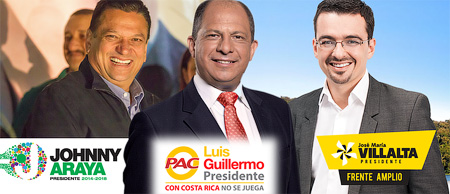
In Costa Rica, Villalta was unexpectedly eliminated from the presidential race, having taken third place among the candidates. The propaganda campaign conducted against him by the local oligarchs and U.S. intelligence, who portrayed him as a «Bolivarian agent» financed by «populist» countries, played a role. «My opponents could not accuse me of corruption, so they called me a communist,» lamented Villalta. Now Araya Monge, the candidate from the ruling National Liberation Party; and Luis Solis Rivera of the Citizens' Action Party, whose political platform is described in the media as «leftist», will fight for victory. However, one should not have any illusions. The “leftness” of Solis Rivera is highly dubious. He has been in good standing at the American embassy since he studied at Tulane University in New Orleans and at the University of Michigan as a Fulbright Scholar. Solis Rivera could be called the political understudy of Oscar Arias, the former president of Costa Rica and an agent of Washington's influence in Central America used for systematic attacks on «populist regimes».
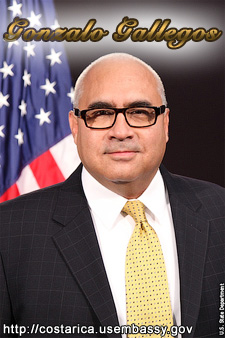 Washington has ensured that it will maintain control of Costa Rica regardless of which of the remaining candidates triumphs in the second round on April 6. Gonzalo Gallegos, who was sent to Costa Rica by the State department in August 2013, is responsible for obtaining the result the U.S. needs. He became acquainted with the local environment twenty years ago, during his first appointment abroad, when he was the Director of the Centro Cultural Costarricense Norteamericano, which has traditionally been used as a cover for CIA agents. He gained additional experience at the U.S. Interests Section in Havana, and then served in Nicaragua, Colombia, and Trinidad and Tobago. His graduate degree in National Security Strategy from the National War College testifies to the nature of his activities. He has also been in charge of cooperation between the State Department and the Pentagon. Among the tasks before Gallegos during his assignment in Costa Rica are reinforcing military ties and ensuring the continued use of Costa Rican territory for the deployment of U.S. Navy ships and Air Force planes.
 The U.S. got the green light to expand its military presence in the country in 2010, that is, when Laura Chinchilla came to power. She was sympathetic to the arguments of the American embassy: Costa Rica is a country through which drugs are transported to the U.S. Costa Rica does not have its own army, so it was implied that America's help would be needed in the fight against drug trafficking. Chinchilla easily persuaded the parliament that such collaboration was necessary. She forwarded a note on the subject from the U.S. embassy to the legislators without translating it from English to Spanish. If one is to believe the news agencies, the representatives voted almost unanimously in favor. Perhaps this is why Costa Rica is increasingly being called a «U.S. protectorate». The Americanization of the country is proceeding at an accelerated pace.
At peak moments of the «war on drug trafficking» or for «humanitarian activities», there may be dozens of ships at bases, from aircraft carriers to amphibious vehicles, as well fighter planes and at least three thousand soldiers, marines and intelligence agents. Costa Rica has become part of a strategic zone created by Washington for the purpose of maintaining control over a large territory rich in hydrocarbons, mineral resources and water. Strategic points of this zone are located in Florida, Puerto Rico, Colombia, Honduras, Panama, Haiti, and the islands of Curacao and Aruba... Costa Rica’s cooperation in the United States’ militarization of the region is perceived with alarm in Nicaragua, as there are unresolved territorial disputes in the countries' bilateral relations, in particular, over the San Juan River. The problem is made more acute by the upcoming construction of the Great Nicaraguan Canal in an adjacent zone. It is theorized that Washington is deliberately trying to stir up conflict between Costa Rica and Nicaragua in order to block this massive Chinese-Nicaraguan project.
In El Salvador, FMLN candidate Sanchez Ceren received almost 49% of the votes. His main rival, Norman Quijano from the National Republican Alliance (ARENA), received 10% fewer votes. The second round will take place on March 9. Sanchez Ceren has stated that in Latin American conditions such a gap in results is practically a guarantee of victory, but his party will make a maximum effort to obtain additional votes, first of all among those who voted for the Unity (Unidad) coalition, which took third place (over 11% of the votes). According to Sanchez Ceren, after the first round Elias Antonio Saca, the candidate from the Unity coalition, called him to congratulate him on his success. Ceren emphasized: «I have no doubt that in the second round we will cooperate with one another.» He also urged entrepreneurs, civil organizations, women, young people, all Salvadorans and all sympathetic political powers to support him and his party.
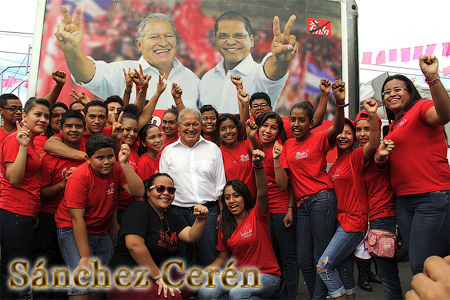
It must be said that ideologically, Unity is closer to ARENA, but conflicts between their leaders are causing this party to negotiate with FMLN. Sanchez Ceren, a former guerilla commander with Marxist views, has become a social democratic politician and is thus basically acceptable to Unidad. Sanchez Ceren was vice president in the first FMLN administration (2009-2014), which was headed by independent politician Mauricio Funes. His inconsistency, preference for neoliberal dogmas in economics, and behind-the-scenes contacts with Americans have more than once evoked the censure of the FMLN political leadership. Thus in the current elections they gave up on the plan of using an «independent» presidential candidate.
Judging by the results of the first round, the electorate has not lost its faith in the party. However, will the ex-Commandante suit the Obama administration as president? Even without him there is a troublemaker in Central America - Nicaraguan Daniel Ortega. He is the source of many problems, maintaining ties with Russia, China, Iran, Cuba, and other countries of ALBA, the Bolivarian Alliance for the Peoples of Our America. For this reason, one may assume that now, behind the scenes of the election campaign in El Salvador, the U.S. Embassy is taking steps to create an ARENA-Unidad bloc. In this case Norman Quijano would have a chance for victory. It bears remembering that in conducting his electoral campaign he has the assistance of Juan Jose Rendon, a specialist in events of this sort living in Florida. The Latin American media has written many times of his accountability to the CIA. He has worked with Colombians Alvaro Uribe and Manuel Santos, Mexican Enrique Pena Nieto and others, greatly easing their ascent to power.
El Salvador has close political and economic ties to the United States, where, according to official data, at least 2.5 million Salvadorans (out of 6 million) reside. In 2013 money transfers from them reached 4 billion dollars. Salvadorans are constantly reminded in various forms that a president unfriendly to the United States will destroy the established harmony of relations, which cannot but affect their prosperity.
In strengthening its position in Central America, the U.S. is simultaneously disrupting the integration process within the framework of CELAC and developing its own project, the Pacific Alliance.